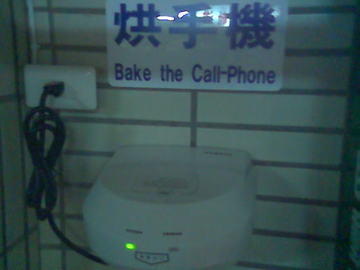
Spotted in a Tainan train station restroom. The sign should have read "Hand Dryer".

Photograph
Smile, I commanded
you obeyed
and I caught forever that
moment
when something on your face
disguised itself
so well
as happiness.
Quiet fears and other
troubles have marred
this day
yet the years will pass
and in time this image
will be enough
to make us
believe
that in this instant
we had been so much
happier than
we really were.
How kind and skilful,
the way time
deceives memory,
erases pain,
fills us with warm
nostalgia for
things that never
really
happened.
The next time they stage a 4-man demonstration for some cause such as increased government transparency, they should also arrange for another 4 group of persons to stand 15 metres and demonstrate for some totally unrelated, and politically neutral cause (for example, "Be Kind to Your Pets").
They should organise both demonstrations in highly similar fashion. For example, both groups stand in the same way and behave in the same way, at the same time of the day. The only difference will be in the messages printed on their placards and T-shirts. For example, the first group's T-shirts may read "More Transparency in the CPF!" and the second group's T-shirts could read "Be Kind to Your Pets".
It will then be interesting to see the police reaction:

Protesters sent packing
Ansley Ng
ansley@newstoday.com.sg
Police dispersed a group of six people who had gathered outside the Central Provident Fund (CPF) building yesterday after receiving several calls that a crowd had gathered at Robinson Road.
The group were protesting against a lack of transparency and accountability in three Government organisations.
Wearing white T-shirts painted with red words and carrying placards printed with the slogan "Singaporeans spend on HDB; Whole life earnings, on CPF; Life savings but cannot withdraw when in need", protesters Monica Kumar, Yap Keng Ho, Charles Tan and Chee Siok Chin arrived at 12.30pm and stood outside the building for nearly an hour before being ordered by police to leave for being a "public nuisance".Ms Chee, the sister of opposition leader Chee Soon Juan, said the protesters did not represent any political party or group.
"We are members of a civil society," said Ms Kumar, who distributed a statement to reporters during the protest.
Using the recent National Kidney Foundation (NKF) saga as an example of how public matters are run in a non-transparent and non-accountable manner, the group called for the Government to be transparent and accountable, starting with organisations such as the CPF Board, the Housing and Development Board (HDB) and the Government of Singapore Investment Corporation (GIC).
Dr Chee arrived with a male companion 10 minutes into the protest and started selling his books just metres away from where the protest was taking place.
Both Dr Chee and the protesters told reporters they were not "connected" with each other.
"If there are no more than five of us, we don't need a permit. This is perfectly legal," said Ms Chee.
At 1.15pm, four police vans from the Neighbourhood Police Centre carrying about 40 policemen of which about 10 carried shields and batons arrived at the scene.
"You have broken the law … an offence of public nuisance. Please disperse now," an officer was heard telling Ms Chee, who at first refused to leave.
Police said they had received several calls that a crowd had gathered at Robinson Road.
After observing the activities of the six people, said the police, they ordered them to disperse.
The four protesters then moved to the side of the building but were again stopped by the police officers.
Their particulars were noted and their placards and T-shirts seized. Police have classified the case as assembly without permit, and causing public nuisance.
The case is under investigation.
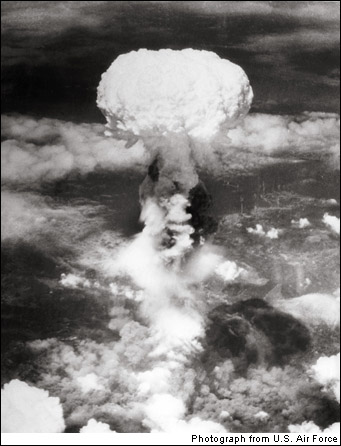
Nothing like the mushroom cloud had ever been seen, not by the general public. It was a suitably awesome image for the power unleashed below. On August 6 the first atomic bomb killed an estimated 80,000 people in the Japanese city of Hiroshima. There was no quick surrender, and three days later a second bomb exploded 500 meters above the ground in Nagasaki. The blast wind, heat rays reaching several thousand degrees and radiation destroyed anything even remotely nearby, killing or injuring as many as 150,000 at the time, and more later. As opposed to the very personal images of war that had brought the pain home, the ones from Japan that were most shocking were those from a longer perspective, showing the enormity of what had occurred.



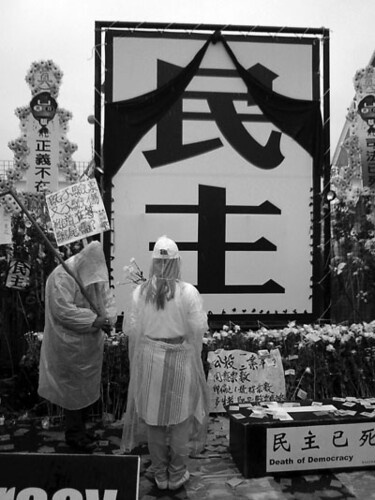
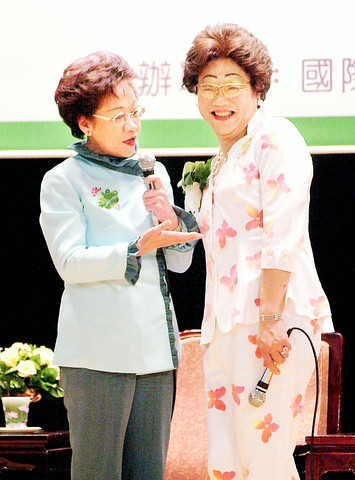
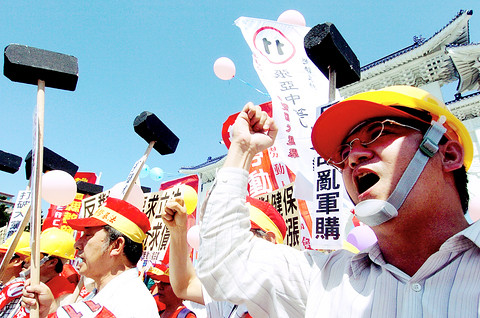
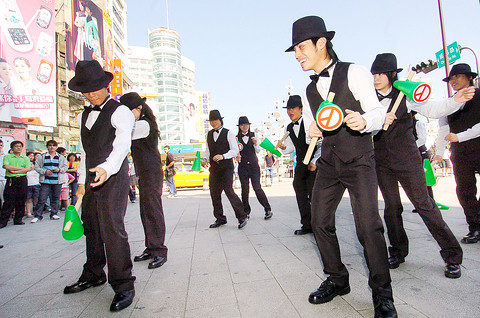
The Singapore Democrats have launched RadioSDP, the first political podcast in Singapore (see announcement on the Home page). SDP secretary-general Chee Soon Juan has given the inaugural address, in which he highlighted the Party's manifesto as well as raise issues regarding transparency and accountability (or the lack of it), NKF, ministers' pay, minimum wage, foreign talent, etc.

State-run Chang Hwa Commercial Bank's (彰銀) shares yesterday nudged up by 1.06 percent to close at NT$19.0 on the Taiwan Stock Exchange, after Singapore-based Temasek Holdings reaffirmed its intention to buy the bank's stakes last week.To secure the support of Chang Hwa's current management, Taishin Financial Holding Co (
台新金控 ), which became the bank's largest shareholder after winning the tender for a 22-percent stake last month, said yesterday that it would support the bank's head in retaining his post.
Nevertheless, Singapore's government-owned Temasek Holdings Ltd, previously the most likely tender winner, reportedly offered in a letter to Chang Hwa's board members last week to buy the bank's common shares and the government's 17.5-percent stake for NT$21.5 per share, leaving Taishin Financial's triumph uncertain.
"We did receive the letter and have written back to Temasek," Chang said yesterday. He however declined to elaborate on the content of the feedback, citing confidentiality.
Temasek's efforts appear to have a slim chance of success, as the Ministry of Finance is unlikely to go back on its promise that the bid winner would be granted preference over the purchase of the government's stake in the bank next year.
Above all markets love the country of Singapore. There was a time a few years ago when one heard this repeated so frequently that it became one of the great media clichés of the age. Singapore was an economic miracle, a land arisen from Third World to First in a handful of decades. Singapore was showing the world the way forward. Singapore had resolved it all: ethnic hatred, crime, social decay, good government. Singapore was the country with the most economic freedom in the world.
And what the market loved best about Singapore was what was absent: Politics. The country has quite literally traded politics for wealth, with its most prominent political thinkers endlessly reminding the world that "Asian values" prioritize economic achievement over civil liberties.
In the Lion City, Americans would find a more sophisticated form of dictatorship, a sort of dictatorship with a double latte. Dissent is crushed not with violence on the streets but with verdicts in the courtroom. Opposition candidates rarely garner enough votes because Singaporean law, written by PAP legislators, renders it easy for government officers to sue their own citizens for slander -- a concept laughable in genuine democracies. Understandably, most Singaporeans prefer to remain silent (or at least temper their criticisms) than risk having their lives ruined by PAP-initiated lawsuits adjudicated by PAP-appointed judges.But intolerance for dissent silences more than just the lions in Singapore. It also renders Singaporeans invisible abroad.
Singaporeans I've met here in Los Angeles are mostly good-natured people, speaking unaccented English and enjoying successful lives. But while exemplifying the American dream, they're also a people who seem painfully ordinary and unwanting of attention -- like those desperately trying to avoid eye contact.
You Are a Pundit Blogger! |
 Your blog is smart, insightful, and always a quality read. Truly appreciated by many, surpassed by only a few. |
Like all journalists and publishers, bloggers sometimes publish information that other people don't want published. You might, for example, publish something that someone considers defamatory, republish an AP news story that's under copyright, or write a lengthy piece detailing the alleged crimes of a candidate for public office.
The difference between you and the reporter at your local newspaper is that in many cases, you may not have the benefit of training or resources to help you determine whether what you're doing is legal. And on top of that, sometimes knowing the law doesn't help - in many cases it was written for traditional journalists, and the courts haven't yet decided how it applies to bloggers.
Link via BoingBoing

One of the highest buildings in the world, the World Trade Center, has strange long grooves on its face...
"Those are the railroad tracks that will take you up to Heaven," an elderly homeless man eagerly explained to me while standing on the corner there.
"All the way up to the Heaven?" I wondered. "And what about gravity? It still works, doesn't it?"
"You gotta have remarkable personal ambition to overcome gravity," smiled the old man. "Everyone in this town has the ambition to go all the way up. When I was still a young fella I tried it myself, but I wasn't strong enough. I only got the first quarter of the way up, then I fell down. That's why I have a limp today. Since that time I've just been standing down here and looking up."
I looked up, too. Alas! There, at the invisible horizon, those grooves seem to converge...
"One more thing, young lady," said the old man. "If you wanna go up, you can use the elevator."
Truly, the wisdom and experience of old age is very hard to beat.

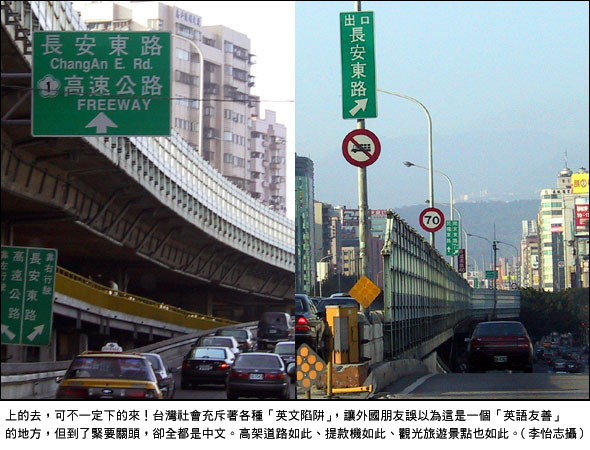
English signs an obstacle to foreign businesses
The Taiwan government has recently been trumpeting the slogan of globalisation and strengthening English language education, and hopes to "double tourist arrivals" by 2008. But according to foreigners here, too few and incoherent English signs are currently the main obstacle facing foreigners in Taiwan, and should be given more attention.
Mr. Gao, an American engineer who works in the Hsinchu Science Industrial Park, remarked that if Taiwan wants to globalize and attract more business travellers, more effort must be made to improve English signs across the island. He feels that English signs are still not widespread enough, and "pose a significant barrier to for non-Chinese speaking foreigners who wish to do independent travel or set up a business in Taiwan".
In addition, the translation systems used by different places produce inconsistent English location names, which Mr. Gao thinks is a big test to foreigners. "The Taiwanese may think that a difference of one or two letters doesn't make much difference, but to a foreigner, he might think that these are two different places." He hopes that the spelling for location names can be standardized, so that different spellings for the same place doesn't appear on the same road.
ASWJ Editor Mr. Wood thinks that as a native English speaker, requiring every country on Earth to use English might be a bit arrogant, and travelling in a place where English is not spoken can add a certain "feeling of adventure". But if Taiwan wants to develop its tourist industry and double the number of tourists, "we need more English on bus stop signs, road signs and menus", which would undoubtedly be of a great help to foreign tourists.